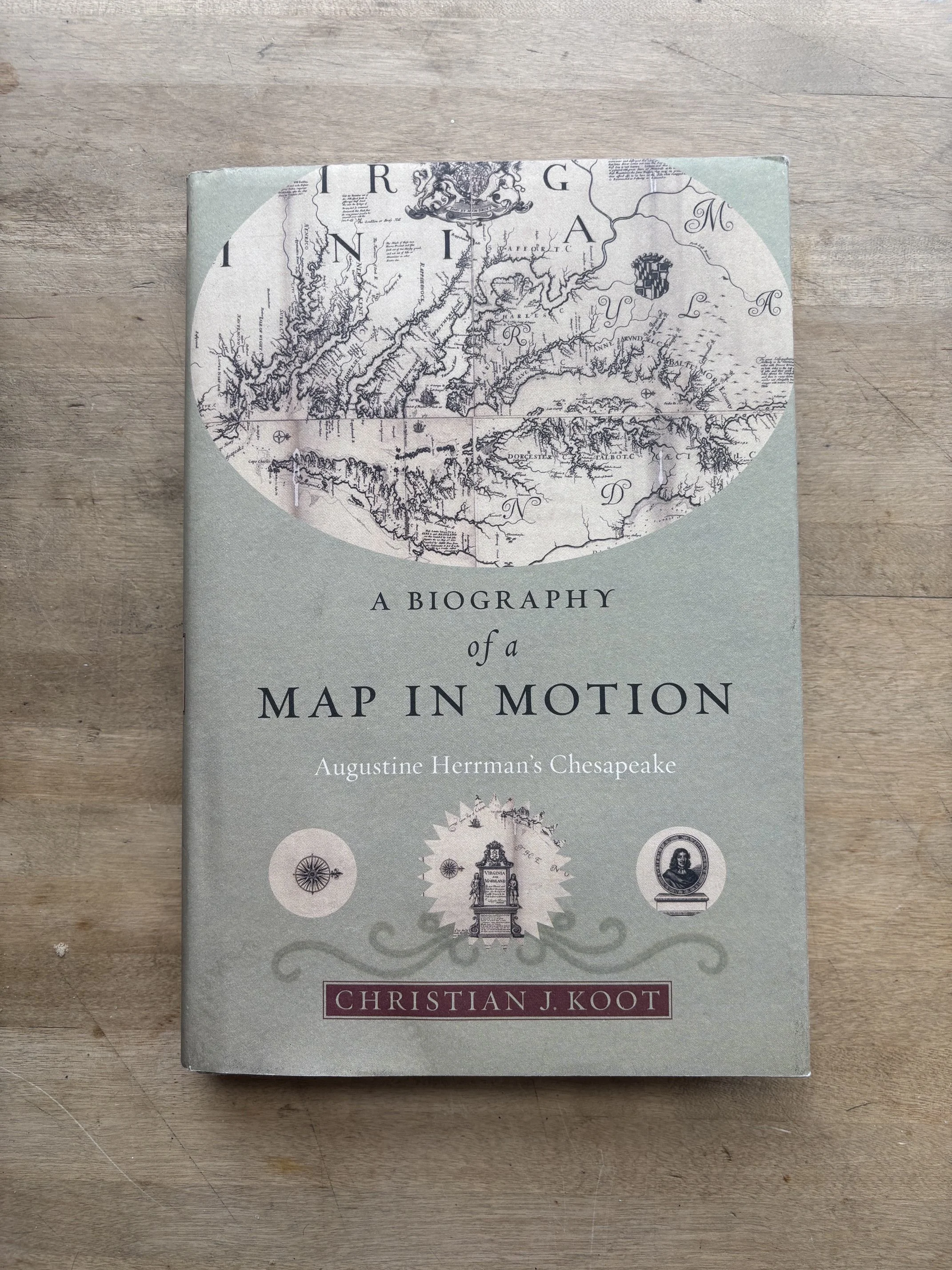
A Biography of a Map In Motion by Christian J. Koot
“Unsurprisingly, early modern Dutch cartography reflects the Dutch geographic imagination and contrasts sharply with early English conceptions of space. While Dutch mapmakers certainly produced territorial maps in the sixteenth and seventeenth centuries, most of their production centered on the creation of detailed city plans and navigational charts on the one hand, and world atlases and wall maps on the other. In contrast, the English map industry began with elite Englishmen’s efforts to demarcate their property with estate surveys. A distinct form of mapping that developed in England during the late sixteenth century, estate surveys differed from most other maps because they sought to represent only one individual’s lands, not to systematically describe the landscape as a whole. Even those cartographers who looked to integrate these distinct renderings of property into a unified picture of the nation did so in a manner that emphasized small regions and their political borders. Christopher Saxton, for example published a royally sponsored Atlas of the Counties of England and Wales in 1579. True to its title, this volume included thirty-four individual maps depicting the counties of England and Wales as well as a small overall map of the two kingdoms. Together, such estate surveys and Saxton’s maps, which other mapmakers drew on into the eighteenth century, suggest that many early modern English men and women increasingly understood their country as consisting of bounded estates and counties distinct from one another. This tradition differed markedly from the Dutch, who almost completely eschewed estate surveys and instead emphasized navigational charts and world maps that celebrated fluidity and movement.”
-Christian J. Koot, 2018