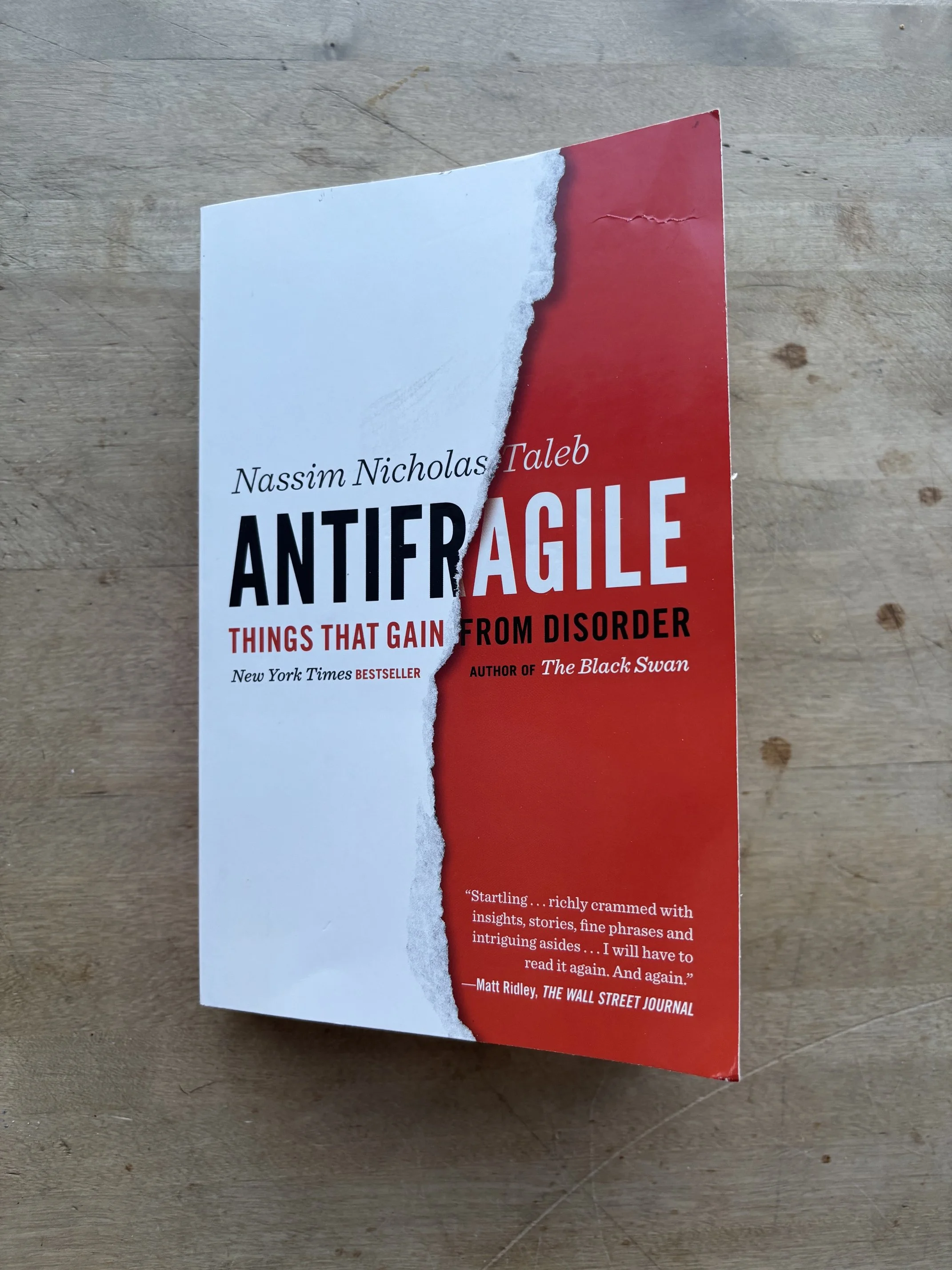
Antifragile by Nassim Nicholas Taleb
“Amateurs in any discipline are the best, if you can connect with them. Unlike dilettantes, career professionals are to knowledge what prostitutes are to love.”
&
“The absence of literary culture is actually a marker of future blindness because it is usually accompanied by a denigration of history, a byproduct of unconditional neomania. Outside of the niche and isolated genre of science fiction, literature is about the past. We do not learn physics or biology from medieval textbooks, but we still read Homer, Plato, or the very modern Shakespeare. We cannot talk about scuplture without knowledge of the works of Phidias, Michelangelo, or the great Canova. These are in the past, not in the future. Just be setting foot into a museum, the aesthetically minded person is connecting with the elders. Whether overtly or not, he will tend to acquire and respect historical knowledge, even if it is to reject it. And the past—properly handled—is a much better teacher about the properties of the future than the present. To understand the future, you do not need inelegant jargon, obsession with ‘killer apps,’ these sort of things. You just need the following: some respect for the past, some curiosity about the historical record, a hunger for the wisdom of the elders, and a grasp of the notion of ‘heuristics,’ these often unwritten rules of thumb that are so determining of survival. In other words, you will be forced to give weight to things that have been around, things that have survived.”
&
“To this day I still have the instinct that the treasure, what one needs to know for a profession, is necessarily what lies outside the corpus, as far away from the center as possible. But there is something central to following one’s own direction in the selection of readings: what I was given to study in school I have forgotten; what I decided to read on my own, I still remember.”
&
“Every line you write under someone else’s standards, like prostitution, kills a corresponding segment deep inside.”
&
“My idea of the modern Stoic sage is someone who transforms fear into prudence, pain into information, mistakes into initiation, and desire into undertaking.”
&
“Books to me are not expanded journal articles, but reading experiences; and the academics who tend to read in order to cite in their writing—rather than read for enjoyment, curiosity, or simply because they like to read—tend to be frustrated when they can’t rapidly scan the text and summarize it in one sentence that connects it to some existing discourse in which they have been involved. Further, the essay is the polar opposite of the textbook—mixing autobiographical musings and parables with more philosophical and scientific investigations. I write about probability with my entire soul and my entire experiences in the risk-taking business; I write with my scars, hence my thought is inseparable from autobiography. The personal essay form is deal for the topic of incertitude.”
-Nassim Nicholas Taleb, 2012